

Best Edge Computing Hosting for Real-Time Web Applications
For over a decade, building a web application meant deploying code to a centralized cloud data center—typically a massive facility like AWS us-east-1 in North Virginia. However, as real-time web applications like live collaboration suites, multiplayer gaming backends, streaming platforms, and instant IoT dashboards proliferate, this traditional model reveals its physical limitations. When an user in Tokyo interacts with an application hosted in Virginia, their data packets must travel thousands of miles through subsea cables, hitting an unbreakable barrier: the speed of light. This introduces an unmitigated latency penalty known as the “us-east-1 bottleneck.”
Edge computing hosting entirely bypasses this limitation. By distributing code execution across thousands of decentralized points of presence (PoPs) globally, edge hosts process compute requests mere miles away from the end user. Choosing the right edge computing host is the single most critical architectural decision for modern real-time applications, determining whether a platform achieves true instantaneous … READ MORE

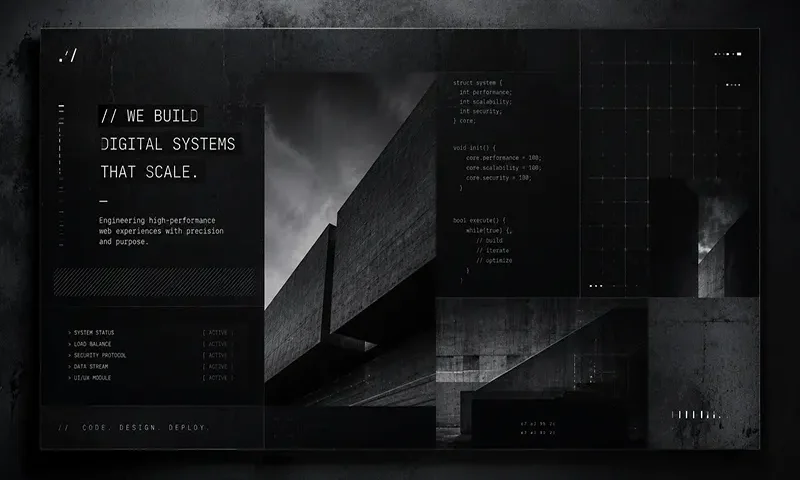
Technical Mono and Code Brutalism Web Design Aesthetic
Walk across the modern internet, and you will experience a profound sense of digital déjà vu. Driven by the homogenization of uniform utility frameworks, predictable landing page templates, and safe, focus-grouped corporate design systems, millions of web applications look identical. Soft blue gradients, generic rounded corners, pill-shaped buttons, and vast expanses of empty space dominate the landscape. It is an aesthetic built to avoid offending anyone—but it also fails to excite anyone.
In response to this corporate saturation, a rebellious counter-cultural design movement is sweeping through developer utilities, Web3 infrastructures, indie hacker repositories, and cutting-edge design agencies in 2026. This aesthetic rejects polished artificiality in favor of a raw, uncompromising architectural style: Technical Monospaced Typography paired with Code Brutalism. Far from being an accidental or unfinished mistake, this design philosophy represents an intentional, anti-decorative statement that celebrates engineering truth, structural transparency, and high-performance digital minimalism.
Defining the Pillars of
… READ MORE

Secure Online JSON to TypeScript Interface Converter
In modern web development, type safety is no longer a luxury—it is a baseline requirement. TypeScript has revolutionized the way we build applications by catching errors at compile time rather than runtime. However, a constant point of friction for frontend and full-stack engineers is onboarding external data. When consuming data from legacy REST APIs, third-party webhooks, or complex microservices, developers are routinely handed massive, un-typed JSON payloads that must be mapped manually into clean TypeScript interfaces.
To save time, engineers frequently turn to free web utilities to automate this conversion. But this common shortcut introduces a massive, hidden security blindspot. Pasting raw corporate data, proprietary API responses, or payloads containing Personally Identifiable Information (PII) into unvetted online tools risks data exfiltration, server-side data logging, and clipboard hijacking. Utilizing an online converter should never mean compromising data security. As developers, we must understand the mechanics of zero-trust web utilities and choose … READ MORE

Integrating Shift-Left Security into the Web Development Life Cycle
For years, the traditional web development lifecycle followed a predictable but flawed path: design, build, test, and—right before pushing to production—hand the codebase over to the security team for a final audit. In this legacy model, security was treated as a final checkbox. The results were consistently disastrous. Vulnerabilities discovered at this late stage frequently triggered frantic, late-night code rewrites, pushed back hard launch deadlines, or worse, were missed entirely, leading to catastrophic production breaches.
As web architectures grow increasingly complex in 2026, relying on a final gatekeeper is no longer viable. Enter Shift-Left Security. This paradigm shift re-engineers the software development life cycle (SDLC) by moving security auditing, automated testing, and compliance guardrails to the earliest possible phases of development. Integrating security directly into the daily web development workflow is no longer an operational luxury; it is an essential engineering practice required to build resilient software without sacrificing … READ MORE

Bento Grid Layout Examples for Responsive Web Design
The world of user interface design moves in distinct cycles, shifting from the hyper-skeuomorphism of the early mobile era to the ultra-flat, sterile layouts that followed. In 2026, the prevailing aesthetic strikes a perfect balance: the Bento Grid. Named after the traditional Japanese lunchbox that compartmentalizes different foods into neat, separate boxes, this layout style organizes content into a cohesive grid of asymmetrical, rounded rectangles.
Pioneered heavily by Apple’s product landing pages and popularized by sleek SaaS platforms and developer portfolios, the Bento Grid has taken the web by storm. But this trend is far more than just a passing visual fad for design-forward tech companies. Beyond its sleek, minimalist aesthetic, the Bento Grid is a highly functional, content-first design pattern that solves complex responsive layout challenges when executed with technical precision. It allows developers to present high information density without overwhelming the user.
The Anatomy of a Successful
… READ MORE