
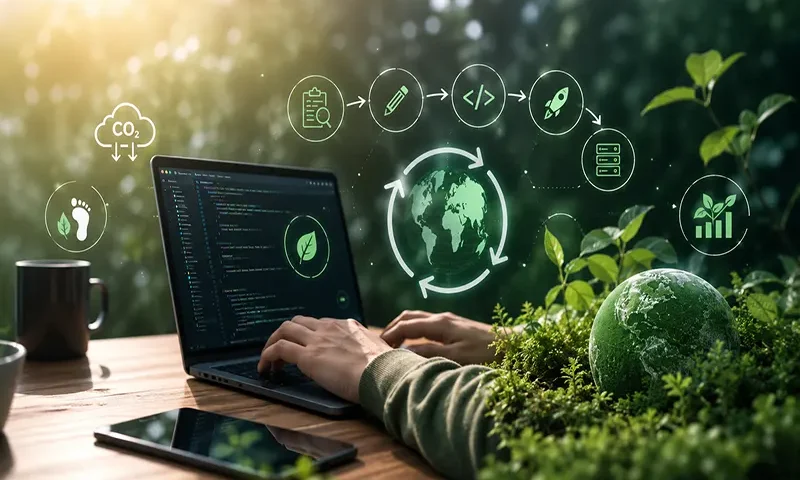
Sustainable Web Development Life Cycle and Digital Carbon Footprint
The global tech ecosystem is often perceived as a clean, weightless cloud. However, the internet is not invisible; it is anchored to a massive, energy-intensive physical infrastructure. Millions of servers spinning inside hyper-scale data centers, vast fiber-optic routing networks buried beneath oceans, and billions of client smartphones and laptops all demand continuous electrical power.
The global digital footprint emits a volume of greenhouse gases equivalent to or exceeding that of the commercial aviation industry. As digital transformation accelerates, web developers and technology executives must confront the environmental realities of their creations.
By transforming the traditional Web Development Life Cycle (WDLC) into a sustainable framework, engineering teams can systematically measure, isolate, and radically reduce the digital carbon footprint of their applications without compromising user experience.
Quantifying the Digital Carbon Footprint: The Mechanics of Data Emissions
To optimize web applications for sustainability, developers must understand how digital assets consume energy. Digital carbon … READ MORE
