
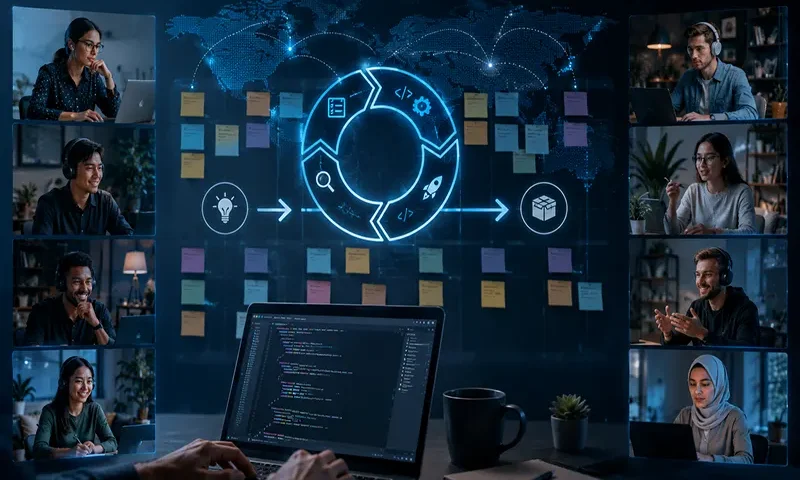
Distributed engineering is no longer a temporary operational compromise or a localized hiring perk; it is a permanent competitive advantage. Building a fully remote or globally distributed engineering organization allows companies to source top-tier technical talent from anywhere on earth, lowering geographic overhead while fostering diverse problem-solving perspectives.
However, a core friction point persists inside this model: the Agile methodology was originally conceived on the assumption of physical co-location. The original Agile Manifesto favored physical whiteboards, daily standups conducted in a literal circle, and instant desk-side debugging sessions. Forcing a distributed engineering team spread across multiple continents into a synchronous, meeting-heavy Scrum structure leads to calendar exhaustion, communication silos, and a massive drop in software velocity.
Successfully executing the Agile Web Development Life Cycle (WDLC) across distributed time zones requires transitioning from synchronous dependency loops to intentional asynchronous processes, backed by deterministic tooling and radical documentation.
Re-Engineering Agile Rituals for Asynchronous Success
To maintain velocity without forcing team members to attend midnight video calls, traditional Scrum ceremonies must pivot away from real-time meetings toward documentation-driven async loops.
A. The Asynchronous Daily Standup
Blocking a single 15-minute window on a global calendar rarely works when engineers are spread across San Francisco, London, and Tokyo.
- Automated Status Bots: Replace the traditional synchronous morning meeting with automated status integrations inside Slack or Microsoft Teams.
- Focused Intersections: Every 24 hours, engineers post their standard updates (what they completed, what they plan to tackle next, and what is blocking them) into a central channel. This leaves synchronous “overlap hours” completely free for solving active roadblocks rather than listening to passive project updates.
B. Global Backlog Refinement & Sprint Planning
When user stories are poorly defined, remote engineers get stuck waiting hours for clarification from a product manager located on the other side of the world.
- The Pre-Read Mandate: Shift backlog grooming to a continuous, document-centric pipeline. Product managers write comprehensive specs, embedding interactive mockups inside digital whiteboards like Miro or FigJam.
- Asynchronous Threading: Team members are given a mandatory 48-hour window to review user stories, post technical clarifying questions directly into threaded comments, and assign story points asynchronously before the sprint officially kicks off.
C. Distributed Sprint Retrospectives
Fostering psychological safety and transparency is incredibly difficult when a team rarely meets face-to-face.
- Anonymous Sentiment Catching: Use dedicated retrospective tools to collect feedback continuously throughout a sprint cycle. Engineers can log operational frustrations or team wins the moment they happen.
- Actionable Commitments: During the retro phase, the Scrum Master synthesizes the anonymous feedback into a shared, transparent board. The team then uses a brief, high-overlap meeting or an async voting process to agree on concrete process improvements for the upcoming sprint.
The Distributed WDLC: Coding, CI/CD, and Accountability
The technical execution phases of the web development lifecycle must be re-engineered to eliminate handoff friction and reduce the time engineers spend waiting for peer input.
[ Local Feature Branch ] ──► Small, Hyper-Focused PR
│
▼
┌──────────────────────────────────────────────────────────────────────┐
│ Automated CI/CD Verification │
│ │
│ ┌────────────────────┐ ┌────────────────────┐ ┌────────────┐ │
│ │ Linting & Security │──►│ Unit & Integration │──►│ Ephemeral │ │
│ │ Static Checks │ │ Suite Running │ │ Preview VM │ │
│ └────────────────────┘ └────────────────────┘ └─────┬──────┘ │
└───────────────────────────────────────────────────────────┼──────────┘
│
▼
[ Async Code Review ]
│
▼
[ Main Branch Merge ]
A. Trunk-Based Development & Smaller Pull Requests
In a co-located office, an engineer can easily manage a massive, multi-week feature branch because they can sync continuously with adjacent developers. In a distributed setup, massive branches paralyze team velocity, leading to brutal merge-conflict sessions.
Distributed teams must embrace trunk-based development, checking code adjustments directly into short-lived feature branches that are merged back into the main branch within 24 to 48 hours. Compressing pull requests into small, single-purpose code changes drastically lowers code review latency across different time zones.
B. Automated CI/CD as the Source of Truth
In a remote-first engineering culture, code quality control must be automated rather than conversational. The Continuous Integration and Continuous Deployment (CI/CD) pipeline serves as the ultimate engineering arbiter:
- Automated Linting and Testing: Every time code is pushed, the pipeline must automatically run code formatters, static analysis checkers, and unit-test suites to ensure strict architectural compliance.
- Ephemeral Preview Environments: Utilize cloud platform capabilities (like Vercel, Netlify, or AWS Amplify) to automatically spin up a standalone, live preview URL for every single pull request. This allows product managers, QA testers, and frontend peers to inspect UI behaviors instantly, completely bypassing the need to pull down branches locally.
C. Transparent Metric Tracking over Presenteeism
Managing a remote workforce requires abandoning the legacy industrial mindset of tracking hours at the keyboard or green Slack availability icons. Engineering performance must be evaluated using auditable Agile delivery metrics parsed directly from your version control history:
- Cycle Time: The average time it takes a single work item to transition from “In Development” to a live production state.
- Lead Time: The total duration from the initial creation of a feature ticket to final deployment.
- Deployment Frequency: How often the engineering team safely pushes code to production, indicating pipeline health and release confidence.
Overcoming the Remote Friction: Security and Isolation
Operating a fully distributed development loop introduces unique security and compliance challenges. Because developers access core code repositories from various networks worldwide, teams must implement strict automated guardrails to enforce organizational standards without manual oversight.
The following configuration block demonstrates a strict, remote-first GitHub Actions branch protection rule template. This configuration guarantees that no remote engineer can force-push code directly to the production branch, and mandates that every pull request must pass all automated integration testing sweeps and secure code reviews before deployment code can be merged:
YAML
# .github/workflows/branch-protection.yml
name: Production Branch Protection Enforcement
on:
pull_request:
branches: [ main, production ]
jobs:
verify-gateways:
runs-quality: true
runs-on: ubuntu-latest
steps:
– name: Checkout Source Code
uses: actions/checkout@v4
– name: Execute Automated Test Suite
run: |
npm ci
npm run test:ci
– name: Security Vulnerability Scan
run: npm run audit-deps
A remote Agile lifecycle is not a compromised, second-rate version of an in-person development engineering team. When you replace synchronous dependencies with automated pipelines, comprehensive pre-read documentation, and clear metrics tracking, you create a focused software engine that runs continuously around the clock.

